
Culture Room Article
7 Games to Play With Your Food Safety Team
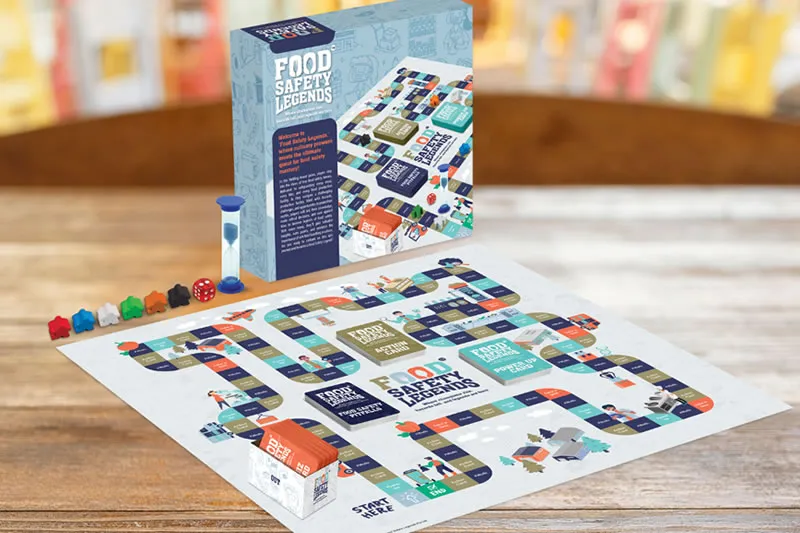
A good food safety game does two things at once: people enjoy it, and they walk away knowing more than they did. Below are seven formats you can run with your team, most built around the Food Safety Legends board game, though the thinking applies to any gamified session. Each one lists what it teaches, how long it takes and the kit you need, so you can pick the right format for the time you have.
At a glance
| Game | Time | Group size | What it drills | Kit needed |
|---|---|---|---|---|
| 1. Full board game session | 45 to 60 min | 4 to 16 | Hazards, corrective actions, regs | The game |
| 2. Knock-out quiz tournament | 15 to 20 min | 6 to 30 | Fast recall under pressure | Quiz cards |
| 3. Department challenge | 30 to 40 min | 12 to 40 | Cross-team consistency | The game |
| 4. Pitfall and Power-Up match-up | 15 min | 4 to 12 | Choosing the right corrective action | Pitfall + Power-Up cards |
| 5. Spot-the-allergen relay | 10 to 15 min | 6 to 20 | Allergen awareness, speed | Allergen quiz cards |
| 6. Toolbox-talk starter | 10 min | 2 to 15 | Applying rules to real incidents | 3 Pitfall cards |
| 7. World Food Safety Day station | rotating | any | Broad refresher, engagement | The game + timer |
1. The full board game session
Run it as designed. Teams race around a food production facility, drawing Pitfall, Power-Up and Action cards and answering quiz rounds.
Best for: a proper 45 to 60 minute training slot where you want full coverage of hazards, corrective actions and regulatory context.
How to run it: split into teams of two or three, appoint one person as quizmaster, and play to a set finish time rather than to a winner so every team gets the same number of rounds.
What it teaches: the complete loop, spotting a hazard, choosing the corrective action, and knowing why the rule exists. See how to play for the full setup.
2. Knock-out quiz tournament
Head-to-head food safety quiz rounds. One question each; a wrong answer or the slowest correct answer is out. Keep going until one person is crowned Food Safety Champion.
Best for: Quality Week, a shift-change competition, or the last 20 minutes of a longer session.
How to run it: draw two names, ask both the same question, faster correct answer stays in. Run a losers’ bracket if you want everyone to play at least twice.
What it teaches: quick, confident recall, the kind you need on the floor when there is no time to look something up.
3. Department challenge
Production versus warehouse versus dispatch versus cleaning. Each department plays a round and you total the scores.
Best for: sites where food safety consistency between teams is the real weak point.
How to run it: same question set for every department, scored out of the same total, results on a whiteboard. Announce the winner at the next team briefing.
What it teaches: beyond the content, it builds the cross-departmental relationships that make food safety work in practice, and it shows managers exactly which team needs more support.
4. Pitfall and Power-Up match-up
Lay the Pitfall cards face up. Teams race to place the correct Power-Up, the corrective action, on each one.
Best for: a focused 15 minute drill when you have noticed people can name a hazard but freeze on what to do about it.
How to run it: first team to correctly match all cards wins; each mismatch costs 30 seconds.
What it teaches: the response, not just recognition of the hazard, which is where most teams are weakest.
5. Spot-the-allergen relay
Use the “Spot the allergen” and “Odd one out” quiz cards as a timed relay between two teams.
Best for: allergen-awareness campaigns, or a focused session before a product launch or recipe change.
How to run it: one runner at a time, answer a card, tag the next person. Wrong answers go back to the pile.
What it teaches: allergen recognition at speed, under the same time pressure as a real production line.
6. Toolbox-talk starter
No board needed. At shift start, draw three Pitfall cards and ask: Has this happened here? What would we do?
Best for: keeping food safety visible in the weeks between formal sessions.
How to run it: 10 minutes, standing, one supervisor facilitating. Note any gap that comes up and feed it into the next training plan.
What it teaches: applying the rules to your own site and your own near-misses, which is what makes the training stick.
7. World Food Safety Day station
Set the game up as one station in a World Food Safety Day event on 7 June, alongside a handwashing demo and a hazard-spotting walk.
Best for: big-group engagement days where you want everyone involved without a classroom.
How to run it: rotate small groups through on a timer, three to five minutes per station, so everyone plays a round and leaves with something concrete.
What it teaches: a light, broad refresher that reaches people who never sit in formal training.
No board? Three of these still work
Formats 2 (knock-out quiz), 3 (department challenge) and 6 (toolbox-talk starter) can be run with printed question cards or a slide deck, so you can start today and add the board game later. Games 2 and 6 are also the easiest to fold into an existing shift meeting.
Running one in a South African food business
Used as part of refresher training, games fit naturally around the local calendar: World Food Safety Day on 7 June, Quality Week, and the ongoing refresher training food handlers are expected to receive under South African food safety regulations. Games do not count as your formal training record, but they are an easy way to keep knowledge current between certified sessions and to show auditors that food safety stays on the agenda all year. Teams that want a ready-made format usually start with the food safety games for employees list and pick two or three to rotate.
Why food safety games work
Games let people practise decisions in a risk-free environment, remember more of what they covered, and actually want to take part. Played in teams, they also build the shared language and accountability that a strong food safety culture depends on, which is why facilities keep using them long after the certificate is filed.
Ready to run one? Order Food Safety Legends or read more about food safety training that sticks.
Common questions
What food safety games can I play with employees and adult teams?
Knock-out quiz tournaments, department challenges, hazard-and-corrective-action match-ups, allergen relays and toolbox-talk card draws all work well with adults because they are fast, competitive and tied to real production decisions. All seven formats on this page are designed for adult food handling teams, not for children.
How long does a food safety game session take?
Anywhere from 10 minutes to an hour. A toolbox-talk card draw runs in about 10 minutes at shift start, a knock-out quiz takes 15 to 20 minutes, and a full board game session runs 45 to 60 minutes for complete coverage of hazards, corrective actions and regulatory context.
Do food safety games replace formal food safety training?
No. Games are a refresher and reinforcement tool. They keep knowledge fresh between formal sessions, surface gaps, and build the shared language a strong food safety culture depends on, but they sit alongside your induction and certified training, not in place of it.
Which food safety game works best for World Food Safety Day?
A rotating station works best: set the board game up as one stop in a World Food Safety Day event on 7 June, alongside a handwashing demo and a hazard-spotting walk, and rotate small groups through so everyone plays a round.